Are Tiny Red Spiders Dangerous? Truth About Red Mites
Quick Answer
- Most tiny red bugs like clover mites are harmless to humans and pose little risk
- They cannot bite, sting, or transmit diseases, so there’s no direct health threat to your family
- When crushed, they leave red marks and staining on curtains, paint, or papers
- Related spider mites can damage plants in gardens, while chiggers cause itchy bites
Those little red bugs crawling across your porches aren’t true spiders at all. According to the University of Kentucky Entomology department, most belong to the arachnid family as plant-feeding mites. While their great numbers on homes startle many, these household pests pose no health threat and won’t make you sick.
What Are These Tiny Red Bugs?
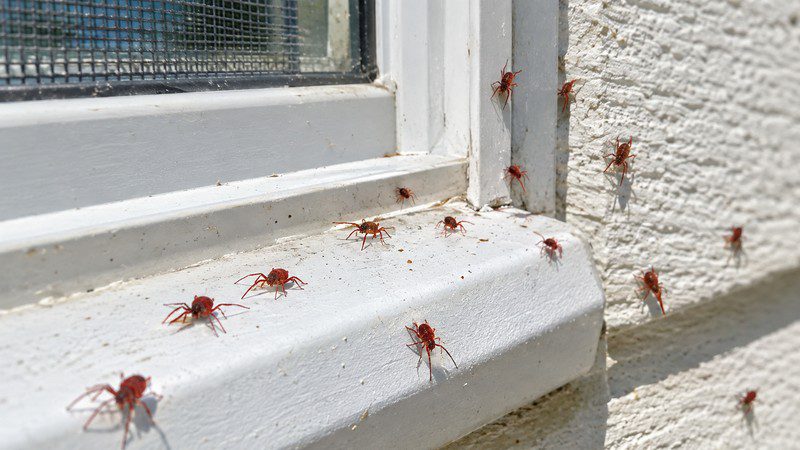
Most people spotting tiny red bugs panic, but here’s the contrarian truth: these creatures rank among the most harmless things you’ll ever find. Scan your outside walls, sunny south-facing surfaces, or thick grass near the foundation, and you’re likely meeting clover mites rather than anything sinister.
The key feature separating a clover mite from a true spider sits up front—those unusually long front legs, stretching nearly twice their body length. According to the University of Minnesota Extension, this odd trait fools homeowners constantly, yet these specks pose zero real threat to your household or health.
Are Tiny Red Spiders Actually Spiders?
Most tiny red bugs aren’t true spiders at all. The four types people spot are actually mites. Spider mites cluster on plant leaves, while clover mites favor sunny outside walls. According to Texas A&M AgriLife, these arachnid relatives lack the classic spider profile entirely, despite appearances. True spiders look and behave quite differently — for instance, if you’re wondering whether black & white striped spiders are poisonous, you’re dealing with an entirely separate creature from these harmless mites.
How To Tell Them Apart
Identifying the culprit starts with size. Clover mites measure 0.75 mm with distinctive long front legs, appearing on outside walls, windowsills, and sunny, south-facing surfaces. According to pest experts, these gather near thick well-fed grass hugging foundations, never posing any real threat to households.
Spider mites stay smaller at 0.4-0.5 mm, with the twospotted spider mite showing brick-red coloring. They cluster beneath undersides of leaves, spinning fine webbing while damaging plants through visible spots and yellowing. Chiggers, meanwhile, are larvae feeding on digested skin cells, leaving itchy welts.
Do Clover Mites Bite?
Homeowners often panic seeing clover mites swarming, assuming these red mites attack skin. The reality reassures: they cannot bite, sting, or spread disease. Lacking mouthparts for piercing people or pets, they simply suck sap from plants, grass, and lawns.
According to the University of Minnesota Extension, confusion arises because chiggers—whose larvae feed on digested skin cells, leaving itchy welts—look similar. Unlike those biters, clover mites stay a harmless home problem, staining walls when crushed, never harming fur or causing mild irritation.
How Fast Do They Multiply?
According to entomology sources at university extension programs, these clover mites operate on a breeding cycle that stuns most homeowners. A single female drops roughly 70 eggs in sheltered spots, and because the large numbers appear during spring and fall, an overnight explosion feels like a major problem materializing from nowhere.
The big waves you notice indoors trace back to weather shifts triggering rapid growth. Are spider eggs visible? Barely, since they hide in cracks and wall voids. Spider mites follow a similar pace, and without intervention these sheltered spots keep restocking populations across each warm season.
What Attracts Tiny Red Spiders To My House?
According to pest control experts, these mites gravitate toward properties surrounded by lush grass, thick weeds, and dense plants near your foundation and walls. Warm sunny doors draw them, while moisture problems, poor drainage, and heavy humidity create ideal conditions inviting them indoors through tiny gaps.
How to Prevent a Clover Mite Infestation
Start by trimming an 18-inch plant-free strip around foundations, since bare gravel blocks their crawl toward windows and doors.
Seal every gap with caulk, install tight window screens, and avoid over-fertilizing thick lawn areas near sunny south-facing walls.
Skip heavy nitrogen fertilizer; per the University of Kentucky Entomology dept, lush grass invites mass clover mites clustering along outside walls.
Keep plant care balanced during dry spells, watering moist habitat zones lightly so spider mite breeding stays quiet across your yard.
Nature helps too, birds and lizards, part of what animals eat spiders and mites, thin populations before spring surges hit.
How to Get Rid of Clover Mites

According to the University of Nebraska Extension, clover mites rarely survive indoors, so crushed bodies leaving red stains on floors, walls, drapes, and clothing signal a larger colony gathering along the sunny side of your structure outside first.
Rather than do-it-yourself control causing frustration and damaged belongings, target wall voids and hard to reach entry points. These tiny little red bugs suck sap from plants, grass, and lawn, so seal out access before they overwhelm your home.
Seeing Spiders at Home?
Get rid of spiders for good — book your free inspection.
Fast, no-obligation quote from trusted local pest control pros.
Should I Vacuum Up Tiny Red Spiders?
Yes, but avoid crushing them since they crush into a red stain. According to the University of Nebraska, use a vacuum fitted with a HEPA bag indoors, or blot gently with a damp cloth. Afterward, seal cracks around windows and doors to block entry.
Are Tiny Red Spiders Harmful To Pets?
Reassuringly, these harmless creatures pose no real threat to pets; they cannot bite, sting, or spread disease to animals. According to entomology sources, they don’t cause infection or carry disease like ticks do. Considered mere nuisance pests, they stay annoying yet completely safe around curious household companions.
Common Myths About Tiny Red Bugs
Myth: These tiny red bugs bite people. Most clover mites don’t bite; among the four types, only certain red mites actually break the skin.
Myth: They spread disease indoors. According to the University of Minnesota Extension, these pests carry no disease and cause harmless red marks when crushed against surfaces.
Myth: They damage plants inside homes. True clover mites feed outdoors on grass and leaves, not household greenery, making common myths about tiny red bugs mostly panic-driven confusion.
Curious Facts About Clover Mites
- Despite their scary look, clover mites are harmless to people and pets, never able to bite, sting, or spread disease to anyone.
- Nearly all clover mites are female, reproducing through parthenogenesis, so a single one can lay 70 eggs without any male clover mite involved.
- Their signature long front legs stretch twice body length, a key feature that fools many into mistaking these 0.75 mm creatures for tiny spiders.
- When crushed, they leave stubborn red stains on windowsills and surfaces, so blotting with a damp cloth beats squashing them outright.
- According to the University of Minnesota Extension, they thrive on thick well-fed grass near foundations, drawn to sunny south-facing surfaces during spring.
- They feed on plants and grass but cause no real damage, appearing in big waves as temps warm up, then vanishing.
When to Call a Pro
Honestly, most tiny red spiders stay a nuisance you handle solo, but persistent large infestation signs shift things. When worst invasions overwhelm outdoor areas despite your effort, or spider mites ravage plants, a professional pest control company brings targeted treatment, exclusion, and lasting growth control.
FAQs
Can Tiny Red Spiders Bite Humans?
Here’s the surprising truth: red mites rarely target people directly. Clover mites don’t bite or feed on skin. However, chiggers cause itchy bites around ankles and waistlines, hiding under tight clothing. Their irritation fades within 1-2 weeks, leaving no disease behind thankfully.
Why Do Tiny Red Spiders Appear Suddenly In Large Numbers?
Population explosions puzzle many homeowners. Female clover mites reproduce through parthenogenesis, laying 70 eggs without males. During the spring wave spanning March through May, warming foundations trigger mass emergence. According to Penn State Extension, big waves follow sudden weather changes predictably each season.
Do Tiny Red Spiders Damage Plants?
Certain spider mites genuinely harm your plants, feeding on undersides of leaves and leaving fine webbing with tiny spots. According to the University of California IPM program, heavy spider mite problems stress dry stressed plants, especially during hot dry stretches. Clover mites, however, rarely damage vegetation directly.
How Long Do Tiny Red Spider Problems Last?
Most clover mite activity runs a short period, roughly 1-2 weeks during spring invasions, then fades. According to Penn State Extension, populations follow seasonal patterns, with a fall return around September and October. Once temps cool, these nuisance pests naturally decline without lasting treatment.