Giant Black Ants in House? Causes & How to Remove
Quick Answer
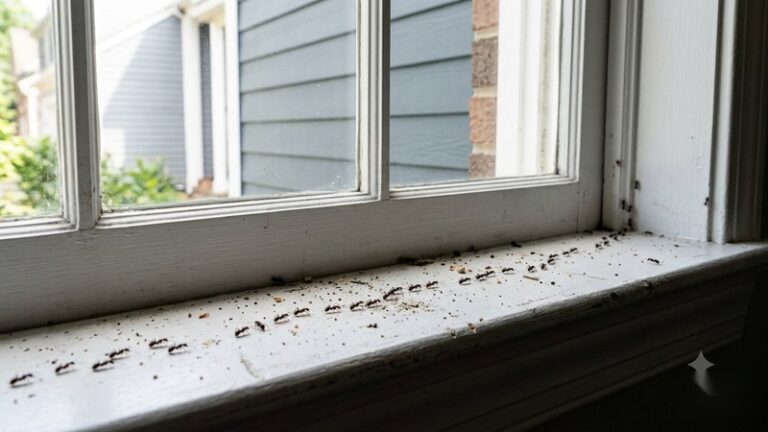
According to pest experts, those large dark insects marching through your home are most likely carpenter ants. These big black ants don’t feed on wood like termites, yet they excavate wood to build nests, leaving fine sawdust behind. Spotting smooth tunnels signals damage threatening structural integrity, demanding swift extermination.
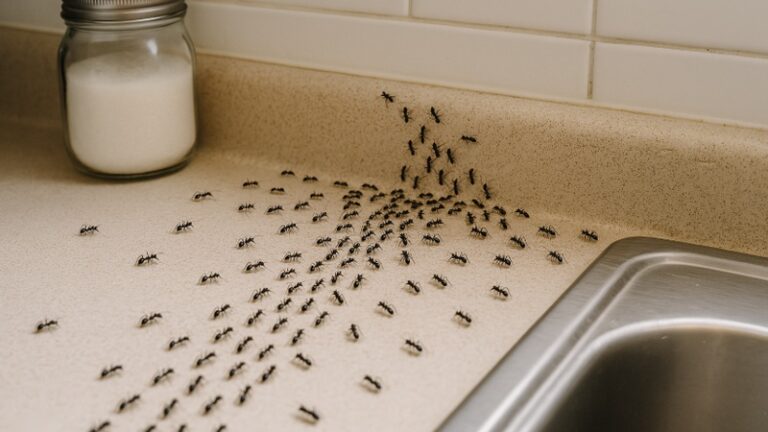
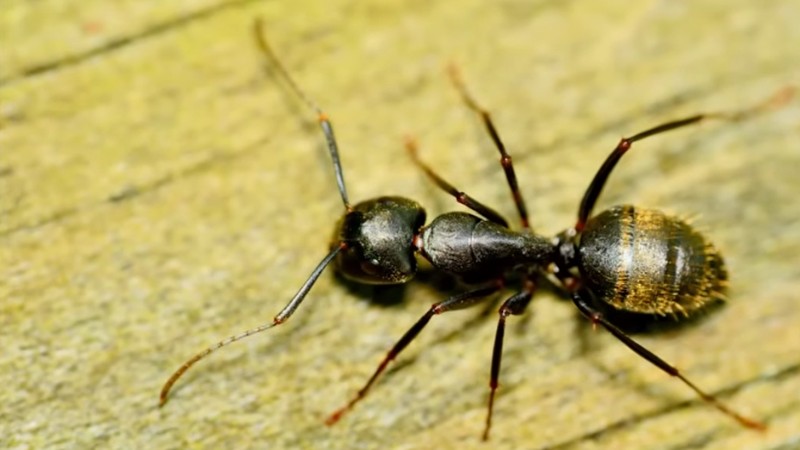
Spotting large dark insects marching across your floor signals trouble. These big black ants, often the black carpenter ant (Camponotus pennsylvanicus), rank among the largest pest ants in North America, easily recognized by their size, black color, and segmented bodies.
According to the EPA, these workers measure ¼ to ½-inch, while queens stretch larger. Unlike termites, carpenter ants don’t feed on wood but excavate moisture-compromised wood, building highly organized societies containing thousands of workers within your home.
What Do Carpenter Ants Look Like
According to Texas A&M entomologists, these large dark wingless ants rank among the largest ant species in North America. Worker bodies span 1/8 to 5/8 inch, appearing black, brown, or red. Within colonies, multiple sizes exist: major workers, minor workers, plus intermediate sizes between castes.
Why Are Giant Black Ants in House?
Most homeowners assume black carpenter ants arrive by accident, but the reality runs deeper. These insects invade your space hunting moisture-compromised wood. According to the University of Kentucky, damp wood and household pests thrive where seepage, plumbing leaks, or rainwater quietly soften structural timbers near foundations.
The draw isn’t your pantry alone. While scent trails lead them toward sweets and pet’s food, their genuine motive is nesting space. Satellite nests form when a parent colony outgrows itself, sending workers indoors through gaps in siding, cracks, vents, or utility lines seeking rotting wood for excavation.
Texas A&M extension specialists note these destructive household pests favor water damaged fascia, bathroom wall voids, and window sills touched by air-conditioning condensation. Wherever decay meets humidity, nesting begins. Your home becomes attractive once moisture problems, leaky pipes, or clogged gutters create the soft wood these colonies quietly demand.
Nest Location
- According to the University of Minnesota Extension, black carpenter ants often establish a mature nest within wall voids where wood stays damp, and a faint rustling sound behind plaster frequently betrays ants living inside before any trail becomes visible to observant homeowners indoors.
- A single carpenter ant nest rarely acts alone; satellite nests branch outward from the parent nest, so finding nest sites means tracking foraging routes during spring and summer when scouting workers expand their reach across your property quietly.
- The mature colonies prefer nesting areas near moisture, and wooden structures with hidden burrows suffer compromised structural integrity through expanding tunnel systems, leading to costly treatments plus future repairs if the infestation stays undisturbed for long stretches of seasons.
- When winged forms appear disturbed indoors, swarmers with wings signal a new colony forming nearby; spotting winged males alongside one ant or scattered individuals suggests control efforts must focus on destroying nest centers fast.
Food Sources
- Carpenter ants are surprisingly opportunistic feeders, raiding kitchens for honey, sugar, and any syrupy bait left exposed, while also harvesting protein from killed insects they encounter along their nightly routes.
- According to the University of Minnesota Extension, these foragers travel impressive distances, following scent trails up to 100 yards from the nest, often tending aphid honeydew outdoors before returning home.
What Kind of Wood Do Carpenter Ants Attack
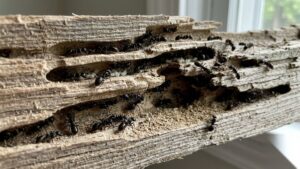
According to the EPA, these ants favor moist wood softened by wood rot, targeting stumps, trees, and landscape timbers outdoors. Indoors, they exploit damp areas near shower drains, firewood, and insulation. Structures like decks, porch steps, wood siding, and foam insulation invite their destructive excavations.
Common Carpenter Ant Nesting Sites
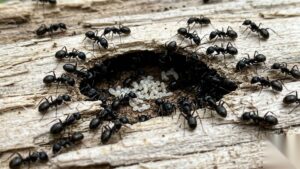
Knowing where these ants set up shop is half the battle. Carpenter ants don’t always announce themselves, so understanding their preferred hiding spots — both indoors and out — helps you catch a problem before it spreads.
In or Outside the Home
Inside, these ants gravitate toward areas where conditions stay damp and the structure has already begun to weaken. Common indoor hideouts include:
- Softer fibers behind walls affected by a leaky roof or plumbing line
- Wet framing near bathrooms, where slow drips create the perfect moisture problems
- Areas with active mold or fungus growth that signal hidden decay
- Decayed wood around window sills and door frames
Outside
According to the University of Minnesota Extension, the bulk of carpenter ant activity originates outdoors before workers ever move inside. Frequent exterior sites include:
- Rotting wood in old stumps and fallen logs near the foundation
- Damp wood in fence posts and deck supports holding ground moisture
- Tree limbs and branches showing fungal growth or interior rot
- Stacked firewood and landscape timbers sitting directly on soil
Biology
Big black ants belong to some of the largest ant species native to North America, and understanding their inner workings starts with the way their colonies are organized. A single mature population is divided into distinct castes, each shaped for a specific purpose. At the center sits the queen, whose entire role revolves around reproduction, while the workers handle foraging, construction, and the daily upkeep of the nest. According to the University of California’s Integrated Pest Management program, these insects do not actually consume the timber they tunnel through; instead, they burrow into it, excavating wood to carve out smooth living chambers, which is why the damage they leave behind reads so differently from that of termites.
What makes these ants particularly fascinating is the physical range found within a single nest. The worker force is polymorphic, meaning individuals appear in multiple sizes rather than a uniform body type. Major workers stand at the larger end of the spectrum and often take on defense and heavier labor, whereas minor workers and those of intermediate sizes manage more delicate tasks. This division by build allows the colony to operate with remarkable efficiency, distributing duties according to the strength and dimensions of each ant. Their bodies are well suited to life inside wooden structures, where they exploit decayed wood and naturally hollowing cavities to expand their reach.
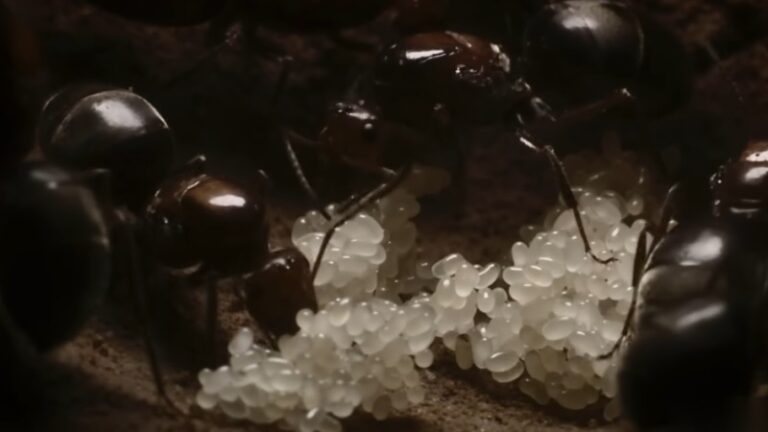
The reproductive biology of these ants follows a seasonal rhythm. As warmer conditions arrive, the colony produces winged reproductive forms, and the female queens alongside the males prepare to disperse and establish fresh populations elsewhere. Their voracious drive to seek out suitable habitat, combined with a body plan engineered for chewing through fibrous material, has made them one of the most destructive wood-dwelling insects in their range. Every generation reinforces the same pattern: a queen founds a nest, workers of varying stature build and provision it, and in time the cycle repeats as new winged individuals leave to begin colonies of their own.
Management
- Sealing entry points and eliminating moisture is the single most effective preventive step, since damp, decayed wood is what draws these ants indoors in the first place.
- For severe infestations, contacting a licensed pest control professional delivers the most reliable outcome. These experts perform a thorough inspection to locate hidden colonies before applying targeted control measures.
- When direct nest treatment isn’t possible, pest controllers often turn to non-repellent residual sprays applied along foraging trails and structural voids, letting workers carry the active ingredient back toward the nest.
- Homeowners can deploy slow-acting bait traps as a practical self-treatment option. The bait’s slow release lets foraging workers spread bait throughout the colony, reaching queen and brood alike. Expect affected ants to die off gradually, usually within 24–48 hours of full distribution, though complete colony decline may take several days.
- Manual removal through vacuuming visible workers and crushing stragglers offers immediate, if temporary, reduction in surface activity.
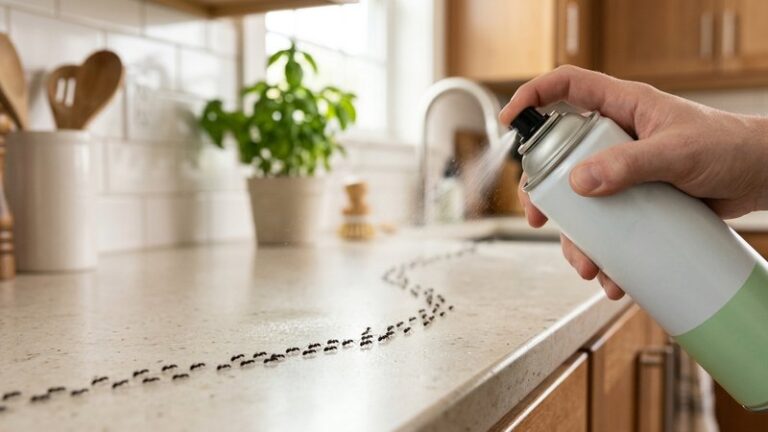
- Spraying contact insecticide directly on individual ants is not recommended. This approach kills only the few ants you see while leaving the protected colony and queen untouched, so it provides nothing more than temporary relief. It also raises unnecessary chemical exposure concerns indoors without resolving the underlying problem.
- According to the University of Minnesota Extension, controlling carpenter ants reliably depends on finding and destroying the nest rather than treating foraging trails alone.
Adapted from guidance published by the University of Minnesota Extension, Jeffrey Hahn and colleagues.
Does Killing Ants Attract More?
Stomping a single ant rarely solves anything—it can backfire. When you start killing ants, their crushed bodies release oleic acid, a chemical death pheromone that alerts other ants nearby. According to Stanford Biology researchers, this signal essentially flags danger, prompting reinforcements to inspect the area. So that lone scout becomes a beacon, drawing curious foragers toward the exact spot you hoped to clear out.
Do Carpenter Ants Bite?
Many homeowners discover that these largest ants can indeed defend themselves when threatened. According to the University of Minnesota Extension, major workers possess powerful jaws capable of breaking skin, though they typically retreat rather than confront people directly inside the house. Unlike smaller nuisance species, telling carpenter ants vs odorous house ants apart often comes down to size and this defensive biting behavior.
When a carpenter ant nest feels disturbed, the female defenders react sharply. Their strong mandibles deliver a pinching nip, and some species spray formic acid into the wound. This sound combination produces a brief stinging sensation rather than a true sting.
According to Pennsylvania State University entomologists, the bite rarely causes lasting harm to healthy individuals. Minor workers seldom bother humans, but provoking ants living inside wall cavities increases your odds of feeling those surprisingly firm mandibles clamp down quickly.
Carpenter Ant Extermination
According to pest professional guidance, eliminating a carpenter ant problem starts with locating the colony headquarters and its satellite nests, not just the visible trailing workers. Containerized bait and granular baits carrying slow-acting insecticides let foragers return food sources to the queen, collapsing the nest within 24–48 hours. Pair barrier treatments, exclusion, and sanitation with thorough inspection afterward.
Still Fighting Ants?
Get rid of ants for good — book your free inspection.
Fast, no-obligation quote from trusted local pest control pros.
Size Variation
According to Texas A&M AgriLife, carpenter workers vary widely, measuring 1/4 to 1/2 inch, while winged queens reach up to one inch. Within one colony, this size range stays conspicuous.
FAQs
What Are Big Black Ants?
Often confused with regular ants that ballooned in size, these larger species are actually carpenter ants. According to entomology resources, their workers measure 1/8 to 5/8 inch, appearing black, sometimes brown or red, forming massive colonies.
Does Killing Ants Attract More Ants?
When you start killing ants, crushed bodies release oleic acid, a death pheromone. According to pest researchers, this pheromone marking signals danger to the colony, prompting surrounding ants to scout and retrieve their fellow workers.
How Long Do Bait Traps Take to Kill Ants?
According to manufacturer guidance, bait traps loaded with sweets work slowly by design. Foragers carry toxins back, spreading them through the colony. Expect full death within roughly 24–48 hours as workers feed each other.